CHECK YOUR MAILBOXES FOR THE THIRD ISSUE OF THIS WINTER’S AVALANCHE REVIEW! NOT RECEIVING THE AVALANCHE REVIEW (TAR) YET? SUBSCRIBE HERE.
We’ve lost some incredible members of our community in the last several months. As we were rocked by a string of tragic news within our industry, a dismal start to winter for much of the West, and other challenges ranging from daily life to global events, more than one of my peers expressed feelings of overwhelm, doubt, and despair.
In recent professional trainings and SAW presentations, I listened to speakers talk about the connection between grief and risk management, and the importance of bearing witness to others’ experiences of loss. As I was putting this issue together, I read a New York Times article about supporting others through grief. The article quoted Dr. Matthew Fleming, a psychologist, former naval office, and chaplain: “Presence matters,” he said. “Sitting with the bereaved. Not even talking. Just soaking in the loss together.”
I think that’s what we, as an industry and community, are doing right now, and it’s what the heart of TAR 44.3 is about. But, we’re also talking about it. We’re taking a closer look at how loss, and other events like near misses, impact our overall well-being and our ability to do our jobs. We’re also feeling the feels, turning inward and reaching out to our friends and colleagues. I think we’re exploring the tools we have on hand—and perhaps noticing that we’re missing some of the implements we need to cope with such immense emotional impacts.
The world shakes, and we change.
This issue centers on remembering four people we lost last fall. Memories of Tina Biddle, Judson Wright, Rod Newcomb, and Wendy Wagner fill almost a third of its pages, describing people who were courageous, curious, enthusiastic, humble, hard-working, and caring. Thank you to everyone who contributed words and photos—and thank you to Sean Zimmerman-Wall, Lynne Wolfe, Aleph Johnston-Bloom, and Eeva Latosuo for helping with outreach and compilation.
It also includes topics on grief, loss, and how we continue existing in the world alongside the void left by those who are no longer in it. Lucas Novak, mountain guide and chaplain, reminds us that we can navigate the gravity of our existence through the grace that we show one another. Following this, August Cary, Emily Paulson, and Brooke Edwards share their personal experiences with loss and grief, and some of the methods and tools they adopted to support their healing. Among these modalities were artwork and poetry. The importance and timeliness of these topics came full circle for me as you all flooded my inbox with artwork, photography, and poetry throughout November and December. This issue includes seven poems.
Another central lesson I noticed is the understanding that “powering through” or putting our heads down, getting back to work, shoving emotions aside, or other practiced methods do not support healing. Sure, there are times when we need to compartmentalize our emotions to stay clear-headed in an emergency. But eventually, we’ll collapse under the burdens we carry if we do not find ways to put them down or lighten the load. More than one author compares the stress and grief we carry to weak layers in the snowpack. Caleb Burns suggests that things like fear and ego can form weak layers within us that will eventually break under stress, but through connection (and bonding), we can heal and ultimately think of our burdens not as something to bear, but as something that connects us.
Finally, Dr. Annie Craig explains the science of how traumatic events and chronic stress impact our central nervous system. We are deeply wired to survive, and repeated stressors can trigger instincts that put us in a continuous stress response—not unlike a deer that is constantly being stalked by a predator. However, using breathing techniques, emotional bonds, and visualizing safety can help us navigate our natural stress responses.
Perhaps this issue is a bit heavy (and if so, Aaron Diamond provides comedic relief on page 47). Hopefully, it provides a salve and maybe even some guidance for processing weighty emotions. If nothing else, it shows how our shared experiences—both painful and joyous ones—can bring us together.
I look forward to hearing more of your thoughts and stories, and seeing the creative ways in which you share them. The submission deadline for TAR 44.4 is February 1-15. Until then, take good care of each other.
— Alli Miles, Editor of The Avalanche Review
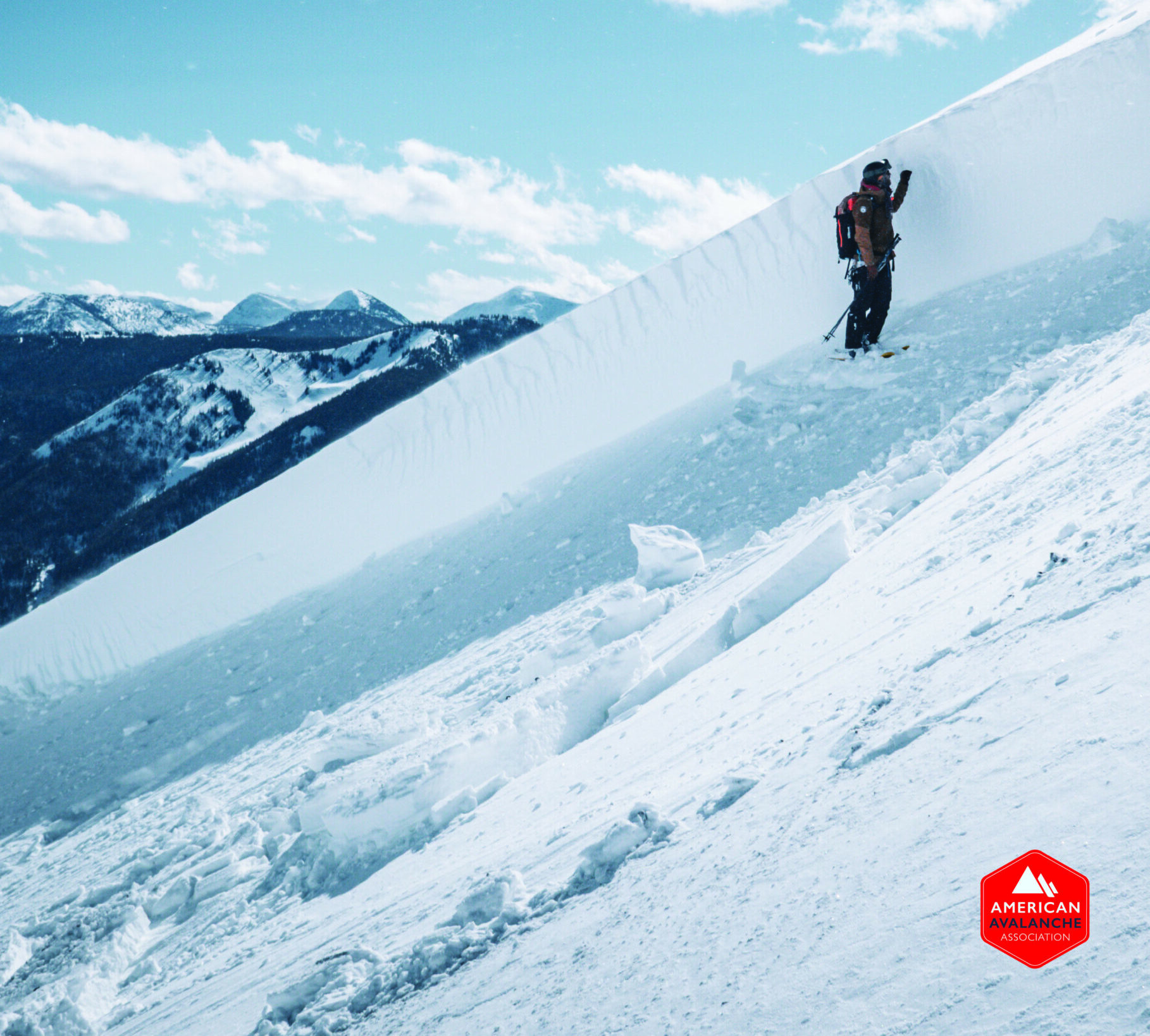
ON THE COVER: Uinta Mountains, Utah. Strong winds regularly form a feature called the “French Roll.” A few weeks after a basal facet cycle in January, Andrew Nassetta and I were performing mitigation work when we had an explosive dud. Due to the difficulty and danger of attempting to disarm or detonate the dud, we improvised a trolley and used the string line to guide another explosive down next to the dud. The result was an eight-pound surface detonation that triggered a D2.5 avalanche on faceted snow near the ground, thus disposing of the dud and mitigating a large avalanche in our terrain. — Bo Torrey